

HOW DATA AND AI ARE DRIVING GROWTH IN THE TOURISM INDUSTRY
Data acceleration projects are playing a major role in the tourism industry today. But developing the right solutions and establishing realistic expectations are critical. Artefact’s report on Data in Tourism examines the outlook for established and emerging destinations and shows why a focused approach is essential to achieve tangible results from investments in data analytics and AI.
“Business leaders can develop data and AI solutions ‘for the business, by the business’ by prioritizing the most impactful solutions,” writes Oussama Ahmad, Data Consulting Partner at Artefact MENA, in his article about a:
Practical Approach To The Business Impact Of Data and AI – Ten Proven Tactics from the Battlefield.
1. Build data solutions by the business, for the business
2. Identify the “right” data solutions
3. Prioritize the most impactful data solutions
4. Assess feasibility of data solutions
5. Build efficient, agile data solutions
6. Accept that some data solutions will fail; scale those that work
7. Share knowledge to help with solution adoption
8. Continuously improve data solutions
9. Maintain robust data governance
10. Define direct impact KPIs to track business impact
THE GROWTH DEADLOCK OF EMERGING TOURISM DESTINATIONS
After stronger than expected recovery last year, 2023 could see international tourist arrivals reach 80% to 95% of pre-pandemic levels this year in some regions, including Europe and the Middle East. However, tourists are expected to increasingly seek value for money and travel closer to home in response to the challenging economic climate.
New tourist destinations find it difficult to compete with established ones because:
Their brand awareness is lower than that of more established destinations
They have limited infrastructure to accommodate large volumes of visitors
They have less expertise in offering distinctive experiences to attract visitors
They’re less visible to regional and international investors and industry partners.
THE FOUR PHASES OF TOURISM DESTINATIONS
Emerging tourism destinations must reach a critical mass to be recognized as a “must-visit” destination.
To ensure this, tourism boards must develop “intelligent” strategies to attract new visitors at every stage, focusing on four interdependent areas:
The “exploration” phase:
Visitors are rare. Marketing capitalizes on the destination’s natural assets to attract early visitors (“adventurers’’). Customer satisfaction data collection begins.
The “emergence” phase: “Trend-setters” arrive. Marketing expands to international visitors. Data collection now includes surveys of international visitors and social media analytics for benchmarking to gain investor confidence.
The “acceleration” phase: The destination achieves critical mass and organically attracts tourists. Tourist segments are targeted with precision marketing analytics, social media insights are leveraged, and publicly available data is used for improved conversion rates and business insights.
The “establishment” phase: Destination brand equity is high. The destination promotes new experiences and attractions using rich tourist data for personalized recommendations and to attract investor interest.
DATA INTELLIGENCE FOR TOURISM DESTINATIONS
Tourism boards or destination authorities need to determine the current phase of the destination, identify strategic imperatives for progression, and prioritize data use cases accordingly.
Planning and performance: Data analytics use cases should be implemented to monitor destination performance, identify root causes for under-performance or opportunities for growth, and set the right targets.
Local and international marketing: Use cases should be focused on monitoring the destination’s brand in each source market, as well as assessing the performance of digital marketing campaigns.
Tourism investment attraction and offerings: Use cases should enable tourism partners to collaborate with each other as well as with government entities to increase visitors and spend, build customized packages and enhance customer experience, as well as monitor return on tourism initiatives and existing investments across destination offerings.
Tourism demand boosting: Use cases should be deployed to ensure a sufficient level of demand to secure a critical mass over and above organic visitation.
Tourist experience enhancement: Use cases should evaluate readiness and visitor satisfaction of tourism destinations and highlight bottlenecks in visitor journeys.
ARTEFACT DATA TRANSFORMATION TOOLKIT: USE CASES & ENABLERS
Artefact has a bespoke library of data use cases for emerging tourism destinations that address every phase of business development: planning and performance, local & international marketing, investment attraction & supply creation, demand acceleration and tourist experience enhancement.
A four-element hard and soft infrastructure is essential to support growth:
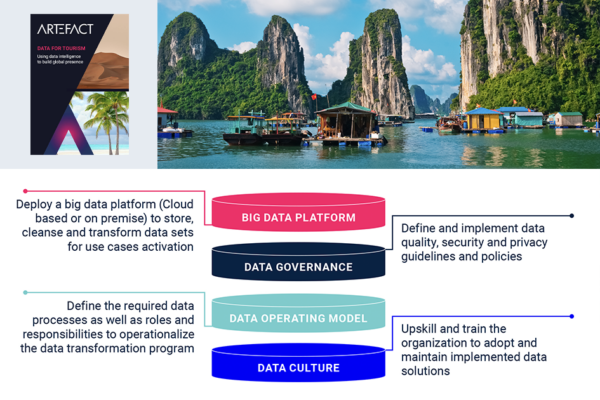
A big data platform for ingestion, storage and analytics.
Clearly defined and implemented company-wide data governance.
A data operating model for clear roles, responsibilities and processes.
A company-wide data culture with continuous upskilling and training.
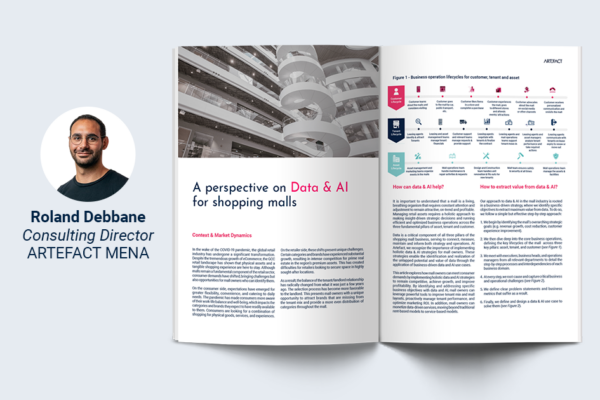
A PERSPECTIVE ON DATA & AI FOR SHOPPING MALLS
Malls must reinvent themselves by focusing on a curated mix of retail and experiential offerings while embedding digital, data, and AI in their operations.
“A mall is a living, breathing organism that requires constant attention and adjustment to remain attractive, on-trend and profitable,” states Roland Debbane, Consulting Director at Artefact MENA.
Managing retail assets requires a holistic approach to making insight-driven strategic decisions and running efficient and optimized business operations across the three fundamental pillars of asset, tenant and customer.
To unlock value and put mall owners ahead of their competition, it’s vital to:
– Interpret visitor demographics and affinities,
– Proactively manage tenant performance,
– Understand the root causes of asset performance and returns,
– Generate new revenue streams through data monetization.
Data-driven use cases such as heatmap analysis can help mall owners gain insights into tenant performance, foot traffic and visitor behavior to make strategic decisions on store lacement and promotional activities.
DOWNLOAD ARTEFACT’S REPORT DATA FOR TOURISM
The Data for Tourism ebook groups the articles above into a unified format.
DATA CONSULTING | DATA & DIGITAL MARKETING | DIGITAL COMMERCE