

THE FUTURE OF LUXURY
THE ROLE OF DATA AND ARTIFICIAL INTELLIGENCE
Artificial intelligence is giving luxury fashion brands sophisticated new ways to reach customers and boost revenues
Despite recent downturns in the global luxury market, the global economic outlook is improving, and recovery, albeit on the lower side, is expected for the coming years.
The global luxury goods market, estimated at $242.8 B in 2022, is projected to reach $369.8 billion by 2030, growing at a CAGR of 5.4% over 2022-2030.
The U.S. market is estimated at $53.1 billion, while China is projected to grow at a CAGR of 7.3%.
Other notable geographic markets are Japan and Canada, each forecast to grow at 4.2% and 5.6% respectively over the 2022-2030 period.*
Although traditionally considered an “impulse purchase”, the decision journey for luxury purchases is actually longer than previously believed. Research now shows that luxury consumers engage with brands at more than ten touchpoints before making a purchase, with 60% of these touchpoints occurring in the digital space.
*Source: Research and Markets, March, 2023
The Artefact report on Data for Luxury How Data is driving the luxury market
“Why has data become key to the luxury industry? It’s all about the consumer. How do you target the right consumer in the digital maze? With data. Deliver a personalized experience, online or offline? With data. Know what to say, when to interact, how to sell? With data. Ensure each point of sale has the right products and services? With data. You need data to win over consumers – and stand out against the competition.”
Edouard de Mézerac, Artefact APAC CEO and Practice Lead of the Luxury sector
Download US Report
Download CHINA Report
Artefact’s international data and AI experts have written a new white paper of 24 pages based on their experience and insights gained from working with the world’s leading luxury brands. We are pleased to share with you some key excerpts from the topics covered in the paper.
The Data for Luxury report explains why the industry’s growth depends on data and AI to streamline the customer journey and build loyalty. Hyper-personalization, experiential marketing, virtual reality, clienteling and many more. Luxury brands need to add tools like these to their marketing & sales arsenals to stay competitive.
Four success factors for Data & AI transformation in luxury
Artefact has identified four key universal success factors to guide luxury brands as they navigate their data and AI transformation journeys.
Success factor #1: Identify the right clients
Luxury brands can help ensure sustainability by nurturing more clients into VIPs with the power of first-party data, to enable a deeper, more granular understanding of customers.
Behavioral data can be leveraged and scored as an indication of purchase propensity among high-potential prospects, repurchasers, VICs (very important customers), and VICs with high churn probability thanks to AI and machine learning.
The results are highly effective, demonstrating a 2~3x increase in conversion rate when activated, compared to organic conversion.

Success factor # 2 – “Prescribe” the right product offerings
Predicting customer preferences might be enough for retailers, but catering to client preferences in the luxury market requires a progressive approach.
AI and data enable brands to go beyond simply suggesting products based on past patterns: they help integrate strategies that focus on upselling and cross-selling to increase customer lifetime value and affinity.
Success factor # 3 – Create tool-empowered omnichannel experiences
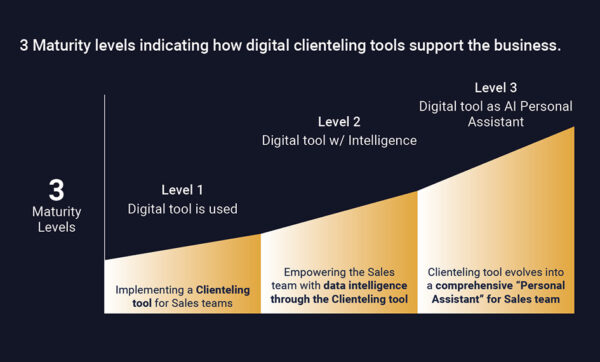
The seamless integration of personalized physical and digital experiences define omnichannel. Sales associates empowered with digital clienteling tools can better interact with customers, make smarter decisions, and deliver customized experiences to each customer to boost conversion.
The tool seamlessly coordinates and integrates all offline and online sales activities, enabling the sales team to boost conversion, whether customers are physically in the boutique or not.
Success factor # 4 – Data and digital is about people

On an organizational level, communication channels that create awareness and facilitate the adoption of data and digital practices must be established.
A collaborative environment that encourages user feedback will allow brands to understand the needs and perspectives of sales teams in the field. And comprehensive training and development initiatives that give sales teams new tools and solutions will enable them to do business in a different, yet enriched way.
A three-step approach to data transformation in luxury
At Artefact, we recommend that brands take the following three concrete steps to develop a successful luxury data and digita
l transformation strategy:
:
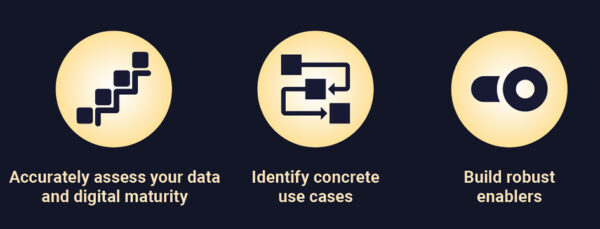
- Accurately assess your data and digital maturity and define a clear vision for your transformation with measurable success metrics.
- Identify concrete use cases that fit with your strategic roadmap and can generate
value in the short term to create excitement.
3. Build robust enablers by investing in the techn
ical infrastructure you need and ensure you have the right tools, systems, and talent to support your data and digital initiatives.
Artefact’s second AI for Luxury & Beauty conference to be held in New-York City on October 5th
Artefact’s second AI for Luxury & Beauty Conference will be held in New York City on October 5th, 2023 at the spectacular Glasshouse Chelsea.
The event will explore the impact of generative AI on the luxury and beauty sectors, with concrete use cases and demonstrations.
170 C-level attendees from the US luxury and beauty sector and over 25 top industry speakers will join us, including Kering, Groupe Clarins, Coty, Google, LinkedIn, Hanro, Aive, etc.
We’re proud to be sponsored by our Gold Partner, Treasure Data, global leader in CDP (Customer Data Platform) technology.
Check out our program here.
Register here: limited places may be available.
DATA CONSULTING | DATA & DIGITAL MARKETING | DIGITAL COMMERCE