



For modern marketing leaders, the pressure to prove ROI has never been higher. Yet, despite having more data than ever, more than 70% of CMOs surveyed report being unable to dynamically adjust their marketing spending based on marketing effectiveness. Many find themselves defending their budgets while trying to strike the right balance between short-term performance and long-term brand building.
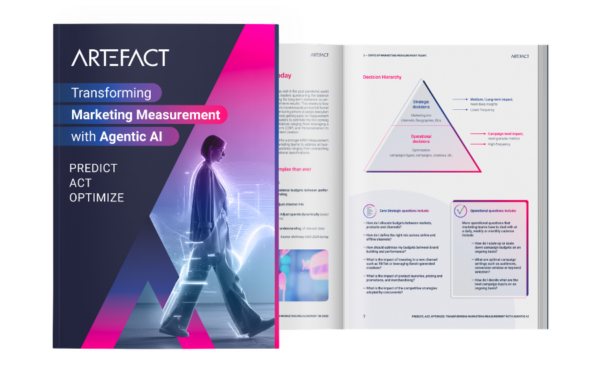
Artefact’s white paper, “Predict, Act, Optimize: Transforming Marketing Measurement with Agentic AI”, demonstrates that, to solve this, industry leaders are turning to a holistic framework known as the “Golden Triangle of Marketing Return on Investment (MROI).” Much like different strategies on a football field, this framework combines three distinct methodologies to answer both strategic and operational questions.
The three pillars of the Golden Triangle
To build an all-encompassing measurement solution, organizations must leverage three complementary tools:
- Marketing Mix Modeling (MMM): Think of MMM as your overall game strategy. It analyzes historical data to quantify the impact of various marketing and non-marketing elements on sales, helping you determine how to allocate your overarching budget.
- Incrementality testing: This is like running specific plays during practice to see what truly works. By comparing a test group to a control group (business-as-usual), you can uncover the true causal impact of a specific marketing tactic, ensuring you are genuinely driving new results.
- 归属: If a goal is scored, which players get the credit? Attribution helps understand the customer journey and assign value to the different touchpoints that led to a conversion. While traditional models relied on basic rules, modern attribution leverages advanced techniques like 夏普利值 (rooted in game theory for fair credit distribution) and Long Short-Term Memory networks (LSTMs) to accurately dynamically model complex, sequential customer journeys.
By scaling our knowledge, use cases, and aligning on the way forward in GEO, we are solidifying Artefact’s position of search innovation.
Balancing short-term activation with long-term brand building
A major challenge for CMOs is properly measuring the impact of brand building. According to the Ehrenberg-Bass Institute’s “95-5 rule,” about 95% of consumers are not actively in the market to buy your product at any given time.
If marketers only measure short-term ROI, they are only optimizing for that active 5%. To succeed, brands must build “mental availability” with the other 95% so that the brand is thought of when those consumers eventually enter the buying phase. Advanced MMMs now integrate brand equity metrics to show how brand building not only lifts long-term baseline sales but also makes short-term performance campaigns more efficient and easier to convert. Ultimately, this allows budgets to be optimized on total Return on Ad Spend (ROAS) rather than just immediate returns.
Real-world successes: Accor and Nike
Transforming measurement isn’t just a mathematical exercise; it’s a cultural one.
在 雅高, the world’s leading hospitality group, the team used incrementality testing to challenge deeply held assumptions. Accor’s Yassine Hachem, SVP of E-commerce & Customer Engagement, noted that they questioned the massive budgets going toward expensive acquisition levers like Search Engine Advertising (SEA). By proving whether those channels generated truly incremental revenue, Accor empowered its decentralized teams to capture more value and optimize spending in a highly competitive landscape.
Nike provides a masterclass in embedding these practices into the company culture. Rather than just buying an out-of-the-box vendor tool, Nike in-housed its MMM capabilities and integrated the insights directly into annual and quarterly planning cycles. More importantly, Nike focused on its people, using its Consumer Marketing Academy to drive data literacy across the organization. Nike’s journey proves that the true value of marketing measurement lies not in having the “best” tool, but in how deeply it is wired into company processes and championed by leadership.
The “in-house” dilemma
As measurement solutions become democratized, companies face a crucial choice: rely on SaaS providers or build these capabilities in-house.
In-housing offers complete customization, retention of intellectual property, and easier scaling across brands. However, it requires a high initial investment and advanced data science expertise. Fortunately, open-source solutions like Google’s Meridian are narrowing the gap, giving capable in-house teams access to peer-reviewed, cutting-edge methodologies without the six-figure SaaS contracts.
What’s next?
Establishing the Golden Triangle is the essential first step, but traditionally, maintaining it requires an immense amount of manual data engineering and modeling. The good news? The manual plumbing of marketing measurement is about to be entirely disrupted.
In part two of this series, we will explore how agentic AI is transforming this space by moving organizations from slow, episodic quarterly reports to an autonomous, always-on measurement ecosystem.

博客