

A week at UKREiiF 2026. As always, it rained throughout. Wi-Fi and 5G were laughable. Some things never change but let’s talk about what has changed since last year.

The mood is grim. Not panicked, just quietly resigned. “We have to keep going” is a sentence I heard a few times. Interest rates are still wrong for the cycle, viability is broken in too many places, and the economic logic of UK development barely survives contact with a spreadsheet. A parade of politicians (Tice, Cleverly, Reeves, Pennycook etc..) all said different versions of the same thing: cut bureaucracy, speed up planning, restore common sense. Light on specifics. Heavy on platitudes. The optimism that papered over the cracks last year has thinned considerably. We are yet again in the midst of political turmoil with no clear path ahead, very ‘Groundhog Day’. The most uncomfortable data point of the week: the latest National Planning Barometer shows build-out, not planning, is now the binding constraint on housing delivery. Consents are creeping up. Infrastructure, viability, and sheer capacity to build are the real choke points.

Property is a human industry. Profoundly driven by relationships. Houses are not traded as a commodity; they are high in value and low in transaction volumes. Vast capital is deployed by surprisingly few people. That it is also emotional and often irrational is hardly a revelation to anyone in the room. These are not good attributes for AI deployment at scale. Use cases tend to focus on back office automation, better data management, and improved decision making. Unlike most sectors, property is one where genuine knowledge of the industry remains a real and durable advantage; there’s a trust issue where execs don’t want Use Cases lifted from other industries.

The hype is dying. What’s left are practical wins. Back office automation, document workflows, and valuation support. Modest, real, beginning to compound. The danger now is not overpromising; it is fatigue. Too many vendors are slapping the AI label on things that are neither novel nor useful. And as we deploy more AI inside property businesses, we are starting to appreciate what humans actually contribute. Look up the doorman fallacy. Replace the function, and you discover, often too late, all the other things the human was quietly doing.

What has changed since last year? AI has become genuinely practical for non-technical users. Costs are down, capability is up, and people are building their own agents without waiting for IT. The constraint is no longer the technology. What firms now need is serious investment in training and change management, strong data governance, and a clear AI framework so employees can experiment safely. We are now doing complex AI implementation projects for £50k and no longer £500k. At Artefact, we now spend most of our time supporting change management and training people to build their own agents instead of doing all the heavy lifting ourselves.

Agentic AI is driving immediate returns. This is no longer theoretical. Agents are taking real work off the desk today, in valuation, research, due diligence, and reporting. Payback is measured in weeks, not quarters. Experienced professionals get to spend their time on judgement, trust, and deal making, which is the only thing that ever justified the fee.

Spare a thought for the SaaS vendors. A wave of niche property SaaS businesses has sprung up over the last two to three years, each training a model to solve a narrow slice of the value chain. ESG reporting. Lease abstraction. Planning queries. Tenant communications. The market is calling what comes next the ‘SaaSpocalypse’, and it is biting in property too. Three forces at once. Foundation models are absorbing these capabilities natively. Clients are doing the work themselves. And nobody wants twelve siloed answers to twelve small problems anymore, they want a holistic view of asset, tenant, lease, planning, and cost in one place. Point solutions in a fragmented industry were always going to age badly. The survivors will be those who stitch into a broader operating layer, or own data the foundation models cannot reach.

Which brings me to data centres. They got more airtime than ever, and rightly so. Many flavours, from hyperscale AI campuses to regional colocation to edge sites, and they are not interchangeable assets. They behave like industrial real estate but underwrite like utilities. The UK problem is unmissable: generation capacity is not keeping pace with demand. Ofgem is sitting on a connection queue of around 140 projects totalling roughly 50 GW, against a current national peak of about 45 GW. Grid connections take up to four years. OpenAI has paused its UK Stargate site citing energy costs and regulatory friction. And the planning system is too slow. According to JLL, a typical UK data centre takes 24 to 36 months to gain consent. Designation as critical national infrastructure shaves only a few months off. For an asset class this fast moving and this capital intensive, nowhere near fast enough. The risk is concrete: the UK quietly slips from the top table of AI investment destinations just as the capital wants to come here. One myth worth retiring: water. Modern AI facilities run on closed-loop liquid cooling and dry coolers. The water story has run well ahead of the reality. The real fight is power.

One counterpoint to the national gloom: the regions. Greater Manchester, the West Midlands, and Yorkshire all turned up with serious propositions, real capital lined up, and a notable lack of waiting for permission from Whitehall. Combined authorities are emerging as the most credible counterparties in UK real estate right now, in many cases more so than central government. If you want conviction and momentum in 2026, look to the mayors.

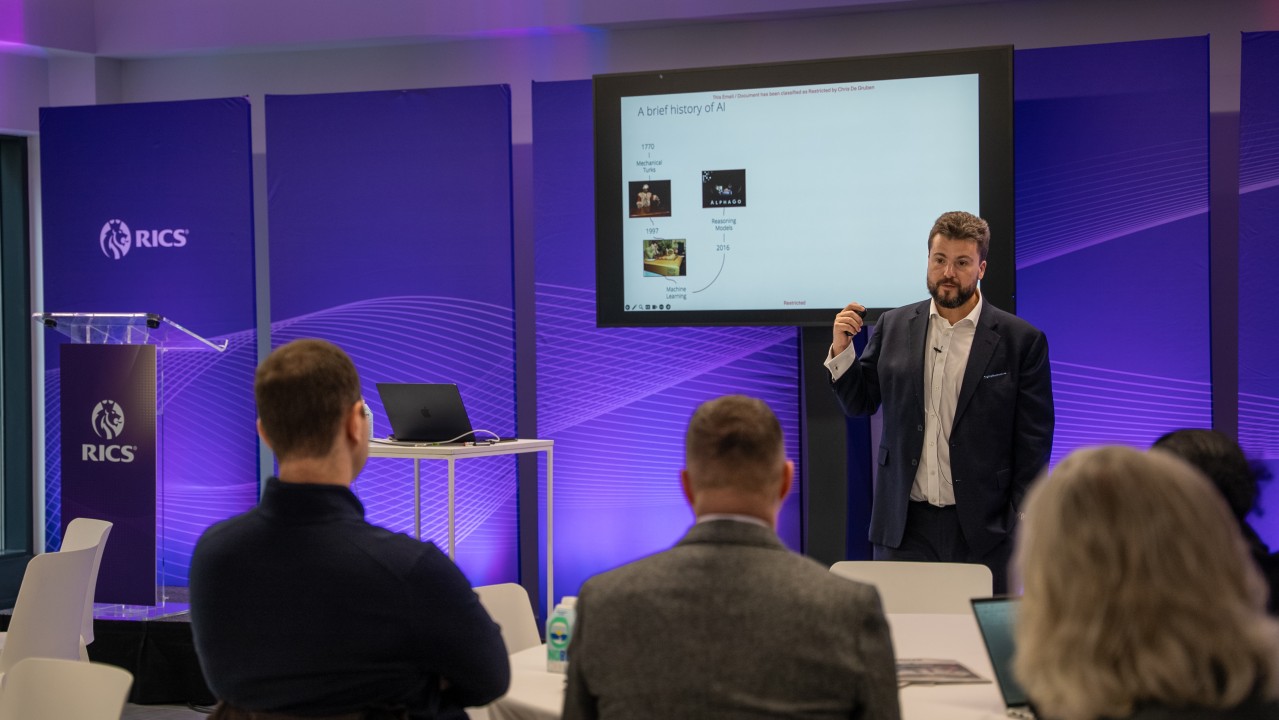
One genuine bright spot. Running the RICS masterclass on AI in surveying practice this week, it was clear that the new AI standards have landed well, with strong adoption across the profession. They guide the responsible use of AI in surveying, and more is coming, including practical guidance for valuers on how to deploy AI in their work. Responsibility is becoming a baseline rather than a brag.